
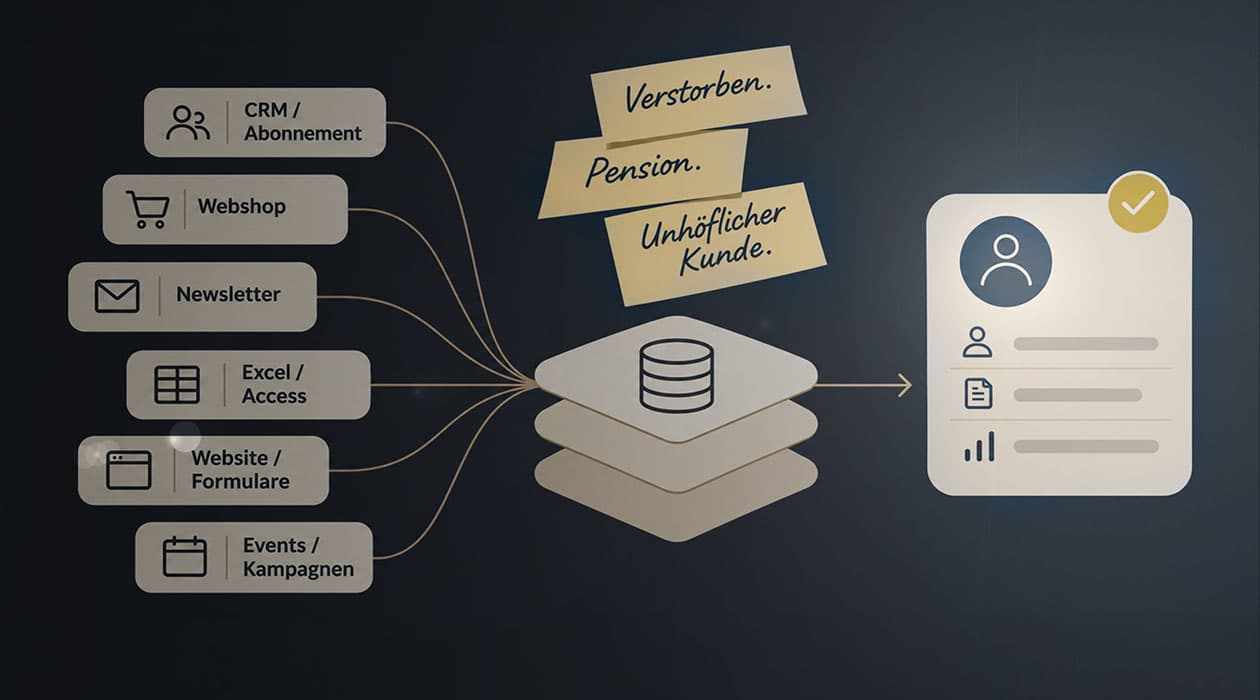
“Deceased.” “Retired.” “Rude customer.” Three entries from a database of around 1.5 million customer records. Each of them could influence how a company deals with a person. Yet they sat among notes and address details, without a consistent meaning for the systems that used them to prepare campaigns, customer lists, or next contacts.
These three notes explain the project almost better than the number of its records. Over the years, a subscription and direct-sales business had collected knowledge: in subscription management, in an advertising address database, in the online store, in the newsletter system, in web forms, at events, and in campaigns. On top of that came Excel files and MS Access databases. Much of it was usable for its respective purpose. The overall picture was spread across those purposes.
Our task was to consolidate the customer data and make it usable for marketing, sales, and customer care. This involved names, addresses, and purchase histories, but just as much the knowledge that had not stayed within the intended columns. People write into a field whatever matters at the moment. At first, the database only knows that there is text in it.
One customer in several systems
Each application described a different part of the same relationship:
- Subscription management knew contracts and terms.
- The online store contained orders.
- The newsletter tool captured part of the communication; the website supplied forms and behavioral data.
- An event added another touchpoint.
- Excel and Access, as so often, handled everything in between.
In such a database, the same person can appear several times: spelled differently, with an old address, or with different email addresses. At the same time, similar entries can refer to different people. Even the seemingly simple question of which records belong together therefore requires a business decision. A match by name is quickly built. A reliable connection between person, company, and transaction takes more work.
The work included:
- Data migration
- Cleansing and normalization
- Duplicate and address matching
- Validation of email addresses
Behind these terms lies a long series of small differences. Spaces and spellings are comparatively easy to standardize. With contradictory addresses, you first have to clarify what the details actually mean and where they come from.
A delivery address can differ from the billing address without either being wrong. A business can continue to exist while its previous point of contact retires. The task therefore also meant preserving differences that matter to the business. Cleansing must not remove precisely the information that explains the connection.
From database to customer model
The overview shows the steps described in the project, from the scattered sources to their use within the company.
Around 1.5 million records from subscription management, the online store, newsletters, the website, Excel, Access, campaigns, and trade fairs are imported and cleansed. Two steps then run in parallel: identities and contact details are matched; free-text entries are classified and analyzed using embeddings. Both feed into a shared customer model and a 360° customer view. Marketing, sales, and management can use the connected information.
What hides in a note
The entry “deceased” carries a different weight than a typo. If it appears only in free text, it can be read, but it cannot be reliably taken into account in all downstream processes. For a system, the contact may still have the same status as before.
The information is stored and yet remains outside the decision.
With “retired,” things become more nuanced. A person can still be reached but may no longer hold their previous position. In a business context, the relevant question may now be who has taken over the role. For that, the data model must be able to distinguish a person from their role. Otherwise, a change in the customer relationship is reduced to an unstructured word.
“Rude customer,” in turn, is an assessment. It reflects the perspective of the person who entered it. Without further context, later customer care lacks the decisive information: What had happened? A complaint, a misunderstanding, an outstanding claim? A subjective label does not support a reliable statement about the entire customer relationship. Even the classification has to respect this difference.
These notes made it clear why data integration is a substantive task. Technically, three strings can be copied into a new database. From a business perspective, they represent a personal status, a change of role, and an assessment. Their consequences differ. Treating them with the same logic loses precisely the meaning for which you wanted to read them in the first place.
How text turned into patterns
In the project, we categorized and classified data, assigned tags, used embeddings, and formed clusters. This made it possible to open up the database through its linguistic content as well. This matters especially in free text: similar circumstances are not necessarily described with the same words.
Embeddings translate text into sequences of numbers that represent linguistic relationships. On this basis, entries with related content can move close to one another.1 For working with a large database, this offers a different approach than searching for a single word. Groups become visible that would remain scattered in a purely literal search.
This does not yet settle the business meaning. Linguistic similarity can reveal a useful connection; whether it leads to the same category or the same action depends on the content. The three short notes make this clear once again. A method can bring conspicuous entries together. The question of what a business then does with them requires an understanding of the customer relationship.
The work therefore took place on several levels. Data was matched, content was analyzed, and the identified connections were translated into usable categories. Tags and clusters made patterns accessible. The customer model gave them a place where they could be viewed together with contracts, purchases, and other information.
For me, this is one of the interesting characteristics of such projects: much of the substance only becomes visible when you read the existing data differently. The source does not have to be new. What is new is the connection made from it.
Provenance is part of the information
At first glance, a consolidated customer profile looks simpler than the many source systems. In fact, it has to preserve part of their complexity. When two sources provide different information, their provenance is decisive for interpreting it. A number or a status without context can look very tidy and still be the wrong basis for an action.
That is why conflict checks and data provenance were part of the work. The central data model connected contact profiles with the relevant business information. Segments, dashboards, and the marketing automation logic were built on this structure. The separate system views turned into a foundation on which relationships could be examined and further processes built.
The consequence goes beyond a more complete contact record:
- A purchase takes on a different meaning in connection with a subscription.
- A response to a topic can be viewed together with previous interests.
- A note from customer service can explain why otherwise suitable outreach would be inappropriate right now.
The individual pieces of information stay the same; how they are used together changes.
In the later business work, questions about customer origin, events, repeat purchases, and complementary offers were added. They followed from the same idea: What can you learn about a relationship when its parts come together? The CRM user stories turned this into concrete situations that the model was meant to support.
The size of the database was only the beginning
Around 1.5 million customer records explain why a manual overall view was hardly possible. The three notes explain why the overall view was needed. Between these two dimensions lay the actual work: consolidating identities, understanding differences, analyzing text, and organizing information so that it becomes usable in a business context.
A company can know a great deal about its customers without having that knowledge available for the next decision. In this project, this could be observed in very small things. In a word in a note. In an old address. In a piece of information in an Excel file that had not reached any other system.
What we opened up was therefore also a kind of organizational memory. The individual memories had long been there. Only their connection revealed what the company already knew about its customers.
More on this engagement in the projects: Customer data consolidation · Customer interests from legacy data · CRM selection · Marketing automation